
Walk into almost any workshop, job site, or warehouse, and the first thing you notice is the stacks. Big sheets leaning against the wall. Plywood most of the time. A few panels of melamine nearby, maybe MDF sitting beside them. Different thicknesses, different labels, same basic shape. Flat panels waiting to be cut into something useful.
What Makes Plywood Different
Cut open a sheet, and the reason becomes immediately apparent. Layers. Thin wood veneers glued together, each one turned so the grain runs in the opposite direction of the one below it. That cross pattern keeps the sheet from twisting the way solid boards do. Wood likes to move with the grain. Plywood pushes back. The layers lock together, and the panel stays stable.
Strength spreads across the entire sheet rather than along a single grain line. A panel can handle weight from different directions. Less warping. Fewer splits. Builders noticed early. One sheet replaced a pile of boards; faster to move, faster to cut, easier to install.
Where Plywood Is Used in Construction
Walk through a house under construction, and plywood shows up everywhere. Subfloors first. Wide sheets spanning floor joists, creating a rigid base before tile or carpet goes down. Roof decking next. Panels nailed across rafters hold shingles in place and help the roof resist wind.
Behind siding or brick, plywood stiffens the building’s frame. Studs alone flex. Add sheathing, and suddenly the structure locks together. The building maintains its shape because those panels tie everything into a single surface.
Furniture shops noticed the same advantages.
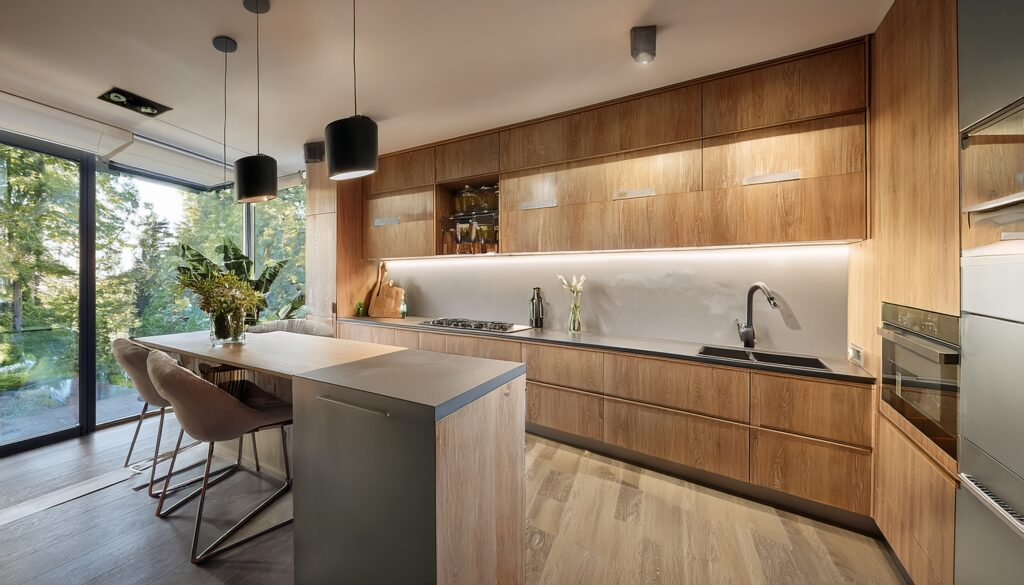
Solid lumber looks great but humidity pushes it around. Boards swell, shrink, sometimes twist. Plywood behaves better. Cabinet boxes, shelves, drawer frames, workshop benches. Large sheets mean fewer seams. The panels cut cleanly and screws grip well enough for everyday furniture construction. Some sheets look good enough to leave visible.
Furniture grade plywood uses thin hardwood veneers on the face. Birch, maple, oak. Sand it, apply finish, suddenly it looks like solid wood. Yet the core stays stable.
Reason One: Plywood Stays Flat.
That stability makes it easier to build large surfaces. Tables, cabinets, floors, roofs. Panels behave predictably. Builders like predictable materials.
Reason Two: Speed and Strength
Four-by-eight-foot sheets cover a lot of area in one piece. Instead of installing dozens of narrow boards, crews install panels. One worker lifts, another nails. Walls get sheathed quickly. Roof decks go down in hours instead of days.
Reason Three: Versatility.
Plywood works in both rough construction and finished projects. Structural grades handle floors and roofs. Cleaner sheets go into cabinetry. Marine plywood is designed for wet environments, using waterproof glue and higher-quality veneers.
Reason Four: Reliability
Plywood holds screws and nails better than many other sheet materials. The layered structure provides fasteners with a solid surface to grip. Cabinet builders rely on that. Shelving, drawer boxes, workshop fixtures. Connections stay tight even after years of use.
Reason Five: Efficiency
It cuts well, holds fasteners, handles structural loads, and is well-suited for furniture building. Few materials cover that range. Veneers used in plywood are thin slices from logs that might not produce wide boards otherwise. More material from each tree. Less waste overall.
Plywood vs MDF and Melamine
MDF (Medium Density Fiberboard) is popular for trim because it machines very cleanly. The material has no grain, so when it’s cut into crown molding, baseboard, or casing, the profiles come out smooth and consistent. Painters like it for the same reason. Paint lays down evenly and you don’t get grain lines showing through the finish.
But MDF has limits. The panels are heavy, sometimes surprisingly so. More importantly, moisture is the enemy. Water soaks into the fibers, and the material swells. Once that happens, it rarely returns to its original shape. Good indoors. Bad anywhere moisture might show up.
Melamine takes a different path. The base panel is usually particleboard or MDF, yet during manufacturing, the surface gets sealed with a thin plastic laminate. The coating is hard, smooth, and stain- and scratch-resistant. The finish is already there when the panel leaves the factory.
Plywood handles that differently. The edge already reveals the layered construction. Veneers are stacked and bonded together. No extra covering required unless appearance matters. It’s part of the structure, not something that has to be hidden.
Need plywood or sheet goods for your next project?
We stock a wide selection of materials, including melamine, domestic plywood, and imported plywood. If you don’t see what you need in the yard, ask us. We have the resources to source a much wider range of panels than what we keep in stock.
Our team can help you find the right material so the job gets done right the first time.